Gridline — a self-governing AI operating system
Gridline is a private, multi-agent AI operating system for creative production and long-running human–AI work. It is not a chatbot, prompt library, or collection of scripts. It is a working AI environment where agents operate under a shared contract, remember across sessions, review each other's work, measure their own performance, and improve over time.
I built it solo in roughly three and a half months — designing the architecture, governance model, operating discipline, and implementation workflow while directing AI coding agents to build the system. Self-taught, outcomes-first, built under real constraints with measurable production results.
Built for the hard part of AI
Most AI projects are built around getting a good answer to one prompt. Gridline was built around the harder problem: making AI useful across sessions, over months, at scale — without losing continuity, context, accountability, or operating discipline.
Work has history. Decisions have reasons. Agents operate under shared rules. Changes are reviewed before they land. Recurring problems become durable improvements. The system measures whether it is getting more reliable over time. That loop is the point — not AI as a one-off assistant, but AI as a governed operating environment.
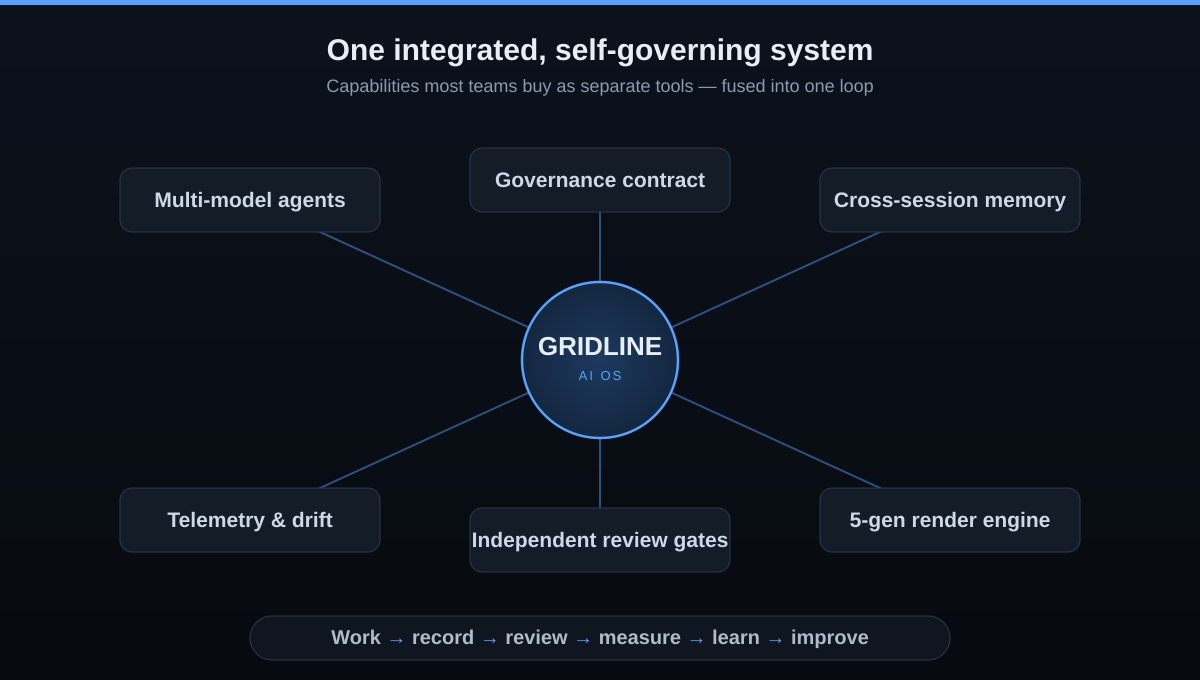
One integrated loop, not five separate tools
Gridline combines capabilities usually handled by separate platforms — agent orchestration, long-term memory, semantic retrieval, change review, governance, telemetry, ticketing, drift detection, and continuous improvement.
It touches the problem spaces of tools like LangSmith, CrewAI, and Mem0 — observability, orchestration, memory — but fuses them into one private, self-governing operating loop. The uncommon part isn't any single feature; it's that the pieces form a coherent, self-correcting system, and that the loop's improvement is visible in the data.
Hard problems solved under real constraints
Running oversized models on constrained hardware
The render engine went through five generations, each rebuild driven by a diagnosed failure — memory exhaustion, allocator fragmentation, models too large for VRAM. The result is a reusable playbook: quantization + staged residency + memory pre-flight gating — running workloads that initially shouldn't have fit.
Multi-agent cost control
An early coordination failure burned a usage budget too fast. That became permanent budget-discipline patterns and circuit breakers — agents get freedom to act, bounded by recoverability, observability, and cost awareness.
Governance that doesn't ossify
The system also learned when to remove controls. Governance ceremony was deleted once telemetry showed it added friction without improving outcomes; an over-built enforcement layer was retired when data showed it wasn't increasing real safety. Governance by judgment, recoverability, and evidence — not rules forever.
Transferable ability
- AI systems architecture
- Multi-agent orchestration
- Governance & safety design
- Operating discipline from first principles
- Infrastructure judgment under constraints
- Telemetry-driven improvement
- Self-directed engineering, no formal CS background
- Human–AI workflow design
The most transferable skill isn't any one tool or model. It's designing the operating layer around AI so useful work continues after the novelty wears off.
Open to work
Applied-AI, agent engineering, forward-deployed / solutions engineering, internal tools, and consulting focused on AI operating systems, agent governance, creative automation, and human–AI workflow design.
Walkthrough, screenshots, architecture notes, and selected telemetry available on request.